Custom Metal Garden Decor for Wholesale
Custom Metal Garden Decor for Wholesale
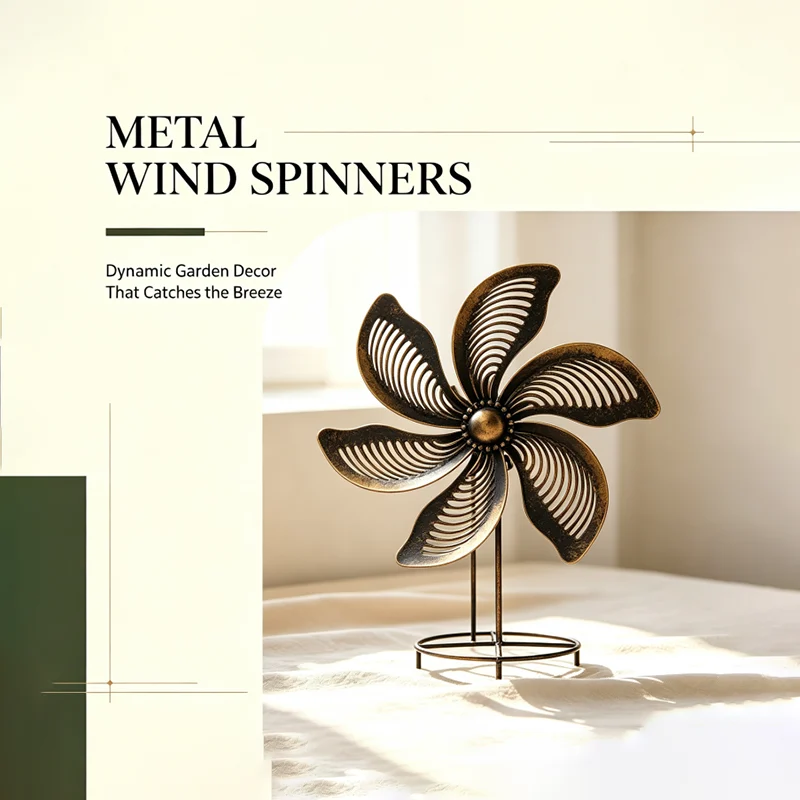
One metal wind spinner changed my entire backyard — and my neighbors’ opinion of it. A gardener’s honest story about finding the garden ornament that finally made everything click.

Let me tell you about the most embarrassing stretch of grass in the neighborhood.
For four years, that was my backyard. The lawn was fine. The fence was fine. The flower bed along the back — hostas, some sad mums, a hydrangea that performed exactly twice — was fine. Everything was fine, the way beige walls are fine.
My neighbor Carol, whose garden looks like it employs a full-time staff of fairies, never said anything unkind. She didn’t have to. She’d wave from her riot of black-eyed Susans and I’d wave back from my beige rectangle of fine.
Then one Saturday in April, everything changed. And the thing that changed it cost less than a nice dinner out.
Here’s what I finally figured out, after four springs of buying more plants and still feeling nothing: my garden had no pulse.
Plants are static. Beautiful, yes, but they sit there. The hostas in June looked exactly like the hostas in July. There was no reason to look twice, nothing that ever surprised you, nothing that ever moved.
I spent a weekend down the rabbit hole of garden forums and Pinterest boards, and the same thing kept appearing in every garden I envied: motion. Swaying grasses, sure — but mostly it was these kinetic sculptures spinning in the breeze. Wind spinners, the comment sections called them.
I was skeptical. The wind spinners I remembered from my grandmother’s yard were rusty pinwheel things that looked like they’d lost a fight with a hardware store.
Turns out the category has grown up. Spectacularly.
I ordered a dual-rotor metal wind spinner in polished stainless steel — the kind with two blades that spin independently in opposite directions, on a tall single stake. Seventy-four inches. I remember the height because I measured my hydrangea for comparison and felt briefly powerful.
It arrived in a long, slim box. Assembly took about five minutes: slide the rotor onto the pole, secure one connecting pin, push the stake into the ground at the end of the flower bed. I positioned it where the path curves — the spot where your eye naturally lands when you step out the back door — and went inside to make lunch.
When I came back out, there was a breeze. And my beige rectangle of a backyard was sparkling.
The two rotors were turning in opposite directions, catching the midday sun and throwing ribbons of reflected light across the lawn, the fence, the side of the house. The hostas hadn’t changed. The hydrangea was still withholding. But the garden had a pulse now. Something was happening.
I stood at the back door holding a sandwich for a genuinely embarrassing amount of time.
I’ve now had that spinner through a full calendar year — spring, a brutal humid summer, an ice storm, and back to spring. A few honest observations for anyone considering the same leap:
The material gamble is real — and stainless steel is the safe bet. I watched a friend’s painted spinner develop rust freckles by August. Mine looks exactly like the day it arrived. If the product listing doesn’t specify stainless steel or powder coating, assume it’s plain painted metal and keep scrolling.
Light wind is enough — if the bearings are good. My spinner starts turning in breezes I can barely feel on my face. The cheap ones I tested at a garden center needed a stiff wind just to creak around once. Sealed bearings are the difference between “garden ornament” and “garden disappointment.”
Placement is 80% of the magic. Mine lives where three things converge: the end of the sightline from the back door, the path of the prevailing breeze, and the western light. Around 5 PM, that spinner catches the low golden sun and honestly upstages everything else on the property. If I’d stuck it behind the shed, it would have been a $60 lawn fork.
The window test is real. My spinner is visible from the kitchen window, where I stand doing dishes twice a day. I genuinely catch myself watching it — spinning fast before rain, dead still on heavy summer afternoons, glittering with frost in January. It turned a window into live programming. Best accidental feature of the whole purchase.
Here’s the thing nobody tells you about wind spinners: they are a social instrument.
The delivery driver asked where I got it. A jogger I’d never met slowed down, pointed, and mouthed “love that.” Carol — Carol of the fairy garden — walked over one evening in October, stood in front of the spinning rotor catching the last golden light, and said, “Well. This changes things, doesn’t it.”
Two weeks later, Carol had her own spinner. A copper-tone one, because Carol could not simply copy me directly. By spring, there were three more on the street. I am not claiming credit for the property values, but I’m not not claiming it.
There’s something about a spinning, light-scattering piece of metal that makes a yard look loved — like someone who cares lives there. People respond to that. I did too, from the other side of the fence, for four years.
Once the spinner taught me what motion does to a garden, I started seeing static spaces everywhere — and fixing them:
The backyard is no longer beige. It’s not Carol-level — let’s not get carried away — but it has a pulse, a personality, and a light show at 5 PM sharp.
And it started with one spinner, five minutes of assembly, and a sandwich I barely remember eating.
The short version of everything I learned, for the person staring at a fine-but-lifeless yard: