Custom Metal Garden Decor for Wholesale
Custom Metal Garden Decor for Wholesale

From corten sun faces to laser-cut tree of life panels, outdoor wall art is the fastest-growing slice of garden decor in 2026. Discover the styles, materials, and placement rules defining the year — plus how custom metal wall art programs work for retailers.
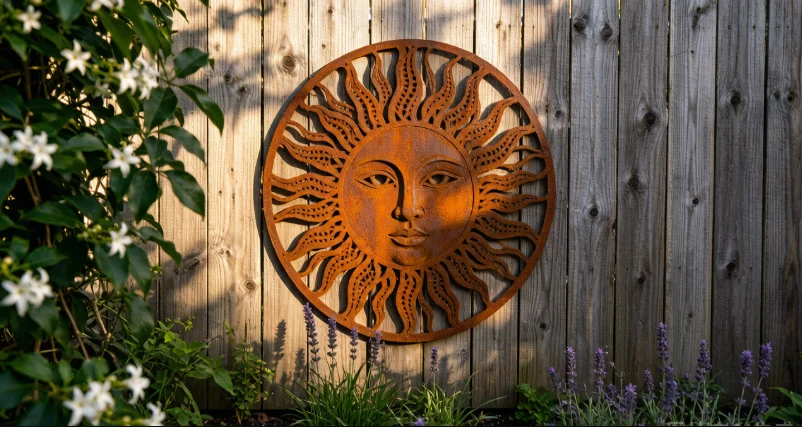
Five years ago, “outdoor wall art” meant a tin butterfly from a garden center clearance rack. It hung on a fence for two seasons, faded to pink, and quietly disappeared into a garage sale pile.
That category doesn’t exist anymore.
Outdoor wall art is now the single fastest-growing slice of garden decor, and what replaced the tin butterfly is something closer to architecture than to ornament: laser-cut corten panels, sculptural tree-of-life compositions, monumental sun faces, and full coordinated wall programs that designers build entire garden rooms around. For the first time, the blank fence behind the border — that awkward rectangle every homeowner pretends isn’t there — has become the most valuable real estate in the garden.
The shift happened quietly because it had to. Plants can’t fix a fence. Furniture can’t fix a fence. Lighting alone can’t fix a fence. A piece of well-designed outdoor wall art fixes the fence — and in doing so, it fixes the entire sightline behind it. That single insight is doing more for the category than any trend report.
Here’s what’s selling, how it works in a real garden, and what the custom-manufacturing side looks like for the buyers putting programs together.
Most fences and blank walls fail for the same reason a bare room fails: nothing terminates the eye. A border’s beauty trails off into a flat plane of cedar or vinyl, and the whole composition collapses at the back.
Outdoor wall art performs three jobs nothing else can in that exact spot:
The trap most homeowners fall into is buying small — a 12-inch piece for a 30-foot wall. Scale is the entire game in vertical decor. A timid piece on a vast wall makes the wall look worse, not better. The pieces defining 2026 are large outdoor wall art — 24 inches and up, often 48 to 72 inches — because that’s the scale at which a wall actually changes.
The sun face wall art silhouette has quietly become the most-imitated form in the category, and the reason is design discipline: a sun face reads at every distance, in every light, against every fence color. The current wave — large corten and matte-black powder-coated steel, often 30 to 60 inches — has moved decisively past the small resin versions that gave the form a novelty reputation. A serious metal sun face on a cedar fence is now a legitimate garden anchor, not a garden-shop souvenir.
Tree of life wall art, single-branch silhouettes (ginkgo, olive, magnolia), and full laser-cut botanical panels are the cottage garden’s vertical backbone. The trend line: more architectural detail than the old printed-wood cutouts, but lighter than solid metal — laser-cut steel silhouettes let the sky show through, so the panel reads as living rather than mass-produced. Botanical wall panels also pair unusually well with climbing plants: a jasmine trained across a steel silhouette is one of the most-photographed garden setups of the year.
A heron in flight, a hovering hummingbird, a row of dragonflies: outdoor metal wall decor in wildlife silhouettes sells steadily across regions and ages, and it’s the form most often gifted. The shift in 2026 is sculptural — flat silhouettes have given way to layered, multi-piece compositions where a bird is built from overlapping steel planes rather than a single cutout. The result catches shadow and movement, so the piece looks different from every angle in the garden.
Metal garden signs — welcome, family names, farm signs, address numbers — have moved from country-kitsch into genuine design territory. The styles doing the work: oversized sans-serif, weathered corten, minimal word counts (one to three words is the sweet spot). The personalization story also opens a category-spanning B2B opportunity we’ll come back to.
The modern-landscape answer to the sun face: full powder-coated geometric panels, pierced steel screens, and lattice compositions. These are the pieces that turn a fence into architecture. They sell best in larger sizes and more conservative palettes — one panel, one bold form, one restrained color.
The smallest segment by units but the most consistent by margin. Oversized metal house numbers, single initial monograms, and short name plaques are the easiest private-label category in garden decor — every home wants one, and almost no one makes their own.
Vertical decor is unforgiving. A statue can hide in a border; a wall panel stares back at you from six feet away through every season. Material matters more here than almost any other category.
| Material | Look | Outdoor Lifespan | Verdict |
|---|---|---|---|
| Corten steel | Architectural, warm rust | 15–25+ years | The modern default — patina is the finish |
| Powder-coated steel | Crisp, any color | 8–15 years | The versatile workhorse |
| Stainless steel | Polished or brushed | 25+ years | Premium, modern, pricier freight |
| Aluminum | Light, any color | 10–20 years | Coastal favorite — salt-resistant |
| Resin / printed wood | “Looks like” metal | 1–3 seasons before chalking | The category’s old reputation, deserved |
Metal wall art earns its dominance for three reasons that show up in real installations: it scales to large formats without the weight penalties that break fences and freight budgets, it accepts laser-cut and plasma-cut detail at a precision other materials can’t match, and its finishes improve with weather. A corten panel gets warmer. A matte-black panel gets more matte. A resin panel gets embarrassing.
The same standing rule applies: if the listing doesn’t name the material and finish, assume it’s the kind that fades.
Wall placement is younger as a design discipline than statue placement, but the principles are crystallizing fast:
The commercial side of the wall art category has organized itself unusually fast — because the buyers are unusually diverse (gift shops, garden centers, home goods chains, hotel FF&E buyers, landscape designers) and the product travels well.
Specialist outdoor wall art manufacturers now run full OEM/ODM wall art programs, which in practice means:
Two category-specific notes for buyers: panel shipping is dimensional, not heavy — the cost driver is size, not weight, so plan palletization and master-carton specs accordingly. And wall art has the strongest gift-giving curve in the entire garden category — welcome signs, house numbers, and personalized pieces peak from late spring through the holidays, which is a different sales arc from statues and planters. A coordinated program across all three categories covers most of the calendar.
The buyers seeing the best results arrive with a target price point, a rough silhouette direction, and an idea of which channel the piece will live in (retail shelf, gift shop, hotel FF&E, landscape install) — which turns an inquiry into a sample run within days.
How do I hang outdoor wall art on a vinyl fence?
You don’t, directly — vinyl can’t hold the weight or the wind load. Mount to the fence posts or install a cleat system on a backer board. Most modern wall art comes with mounting specs rated for the panel’s wind load; follow them.
Will corten stain my fence or wall?
Yes, for the first few rain cycles. Corten’s rust runoff is part of the material’s character — design for it. Mount over stone, concrete, or a backer that can take the patina transfer, or accept the staining as the corten “settling in.”
How big should my first piece be?
Bigger than the piece you’re picturing right now. Outdoor wall art’s most common failure is undersizing. For a standard 6-foot fence section, start at 24 inches and add from there.
Can I leave wall art up year-round?
Metal wall art, yes — it’s designed for it. Resin and printed wood, no; those belong under cover.
Is wall art a gift category or a self-purchase category?
Both, but the gift curve is unusually strong. Welcome signs, house numbers, and personalized pieces make the easiest “housewarming that won’t be re-gifted” purchase in the garden category.
For most of garden design history, the fence was the problem. The plants were the answer, and the wall was just the thing the plants leaned against. Outdoor wall art in 2026 flips that relationship — the wall is now the lead instrument, and the plants are the framing.
The reason is simple: walls don’t lose their leaves, they catch the light at dusk, and they hold a single strong image at a scale nothing else in the garden can match. The right piece of outdoor wall art doesn’t decorate a garden — it completes one.
Whether you’re hanging one corten sun face on a cedar fence, or building a wall art collection that anchors a retail season, the principle is the same. One large piece, placed where the eye lands, built to weather with grace. That’s the whole brief.