Custom Metal Garden Decor for Wholesale
Custom Metal Garden Decor for Wholesale
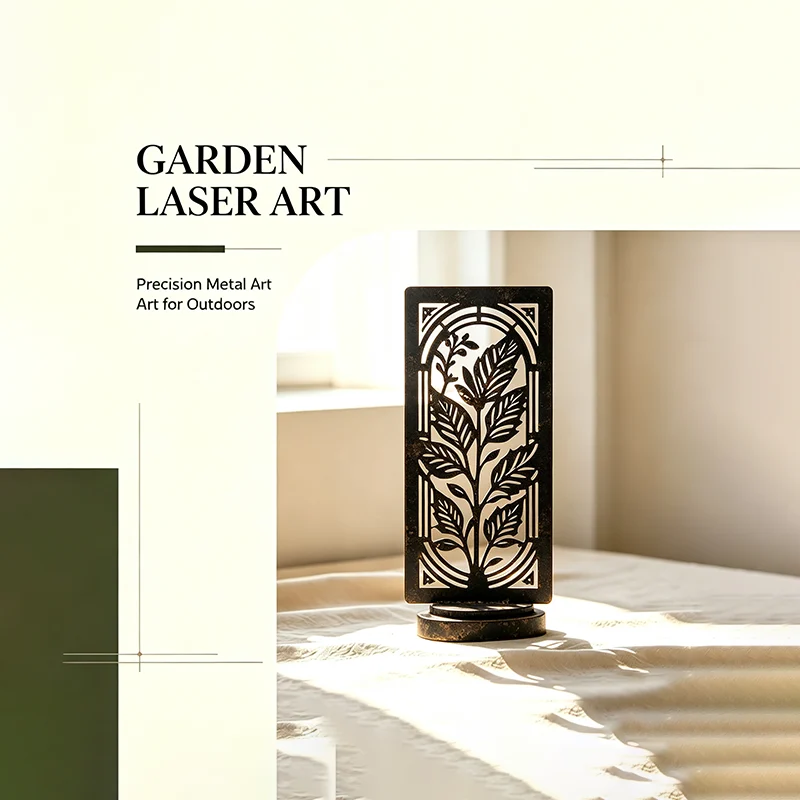
Laser-cut garden art — silhouette stakes, pierced panels, and luminarias — is the precision end of garden decor. Discover what laser cutting actually changes about design, materials, and price, plus how custom laser art programs work for retailers and brands.

Every garden decor category has a ceiling, and for decades the ceiling was the same: whatever a stamping die could press, or a casting mold could pour. A sun face could only be as detailed as its mold. A flower silhouette could only be as delicate as the stamp allowed before the metal tore.
Garden laser art removed that ceiling.
A laser cutter doesn’t push metal into a shape — it burns a line through it, and the line can be as fine as the sheet allows. The same machine cuts a five-inch dragonfly stake at dusk and a six-foot botanical screen for a courtyard, from the same coil of steel, on the same afternoon. That single manufacturing fact has quietly rebuilt the top of the garden decor category: the pieces that photograph best, gift best, and hold margin best in 2026 are, disproportionately, laser-cut metal garden art.
This is the story of what the laser actually changed — for the designs, for the materials, for the price tag, and for the buyers building programs around it.
Most shoppers can feel the difference between laser art and stamped or cast pieces without being able to name it. The difference is threefold, and it’s worth spelling out:
The result is a category with an unusual property: the best-looking piece and the best-engineered piece are usually the same piece. In garden decor, that almost never used to be true.
Single-stem silhouettes — allium, poppy, dahlia, fern fiddlehead — on 30-to-48-inch iron stakes, powder-coated or left to rust. The laser’s fine interior cuts are what make these read as flowers from across the garden rather than “flower-shaped things.” They sell year-round, they flat-pack (nearly), and they’re the entry product that pulls customers into the rest of a laser art line.
The large-format end: laser-cut iron panels used as privacy screens, fence art, and balcony dividers — up to eight feet, with repeating botanical or geometric patterns. This is where laser art stops being decor and starts being landscape architecture: a pierced screen throws patterned shadow that changes with the sun, which no solid panel can do. Designers specify them for exactly that light behavior.
The category’s night product. Laser-cut metal cylinders and lanterns with dense interior patterning, designed so a candle or LED inside throws the pattern onto nearby walls and paving. Photograph extremely well at dusk — which, on the retail internet, is the product. Expect this segment to keep growing as outdoor living pushes later into the evening.
Heron, owl, fox, hummingbird-in-flight — plus narrative compositions (a cat stalking through grass, a reader on a bench) that only work because interior detail is possible. These are the gift segment: recognizable, personal, and impossible to confuse with the stamped imports they share shelf space with.
Laser cutting made connected script possible — cursive “Grow,” “Bloom,” family names — in a way dies never could, because the laser can leave the hairline bridges that hold a script together. Personalized laser art is now the highest-margin, lowest-MOQ custom play in the entire garden category, which is why every serious program includes it.
A laser cuts steel, iron, stainless, and aluminum with equal indifference. What differs is what happens after the cut — and this is where the iron-first logic of serious garden programs comes from:
| Material | Look | Outdoor Lifespan | Verdict |
|---|---|---|---|
| Powder-coated iron | Crisp matte black, any color | 8–15 years | The flagship — best cut-edge finish, best value |
| Raw / rusted iron | Warm, weathering rust | Improves for 10+ years | The honest choice — the rust clockis the design |
| Antique-finish iron | Darkened, hand-rubbed | 8–12 years | The premium look without the premium price |
| Corten-style steel | Architectural rust patina | 15–25+ years | The luxury market’s favorite — expect to pay for it |
| Stainless steel | Bright, modern | 25+ years | Beautiful, costly, overkill for most gardens |
| Aluminum | Light, powder-coated | 10–20 years | Coastal-only logic — salt resistance |
Two iron-specific notes that matter for laser art in particular:
The standing rule applies here too: if a laser art listing doesn’t name the material and finish, it’s the kind that fades.
Laser art is the most forgiving category in garden decor to place — but a few rules separate the installations that get photographed from the ones that get ignored:
This is where garden laser art stops being a product story and becomes a program story — and it’s the category where custom manufacturing is structurally easier than anywhere else in garden decor.
The reason is the machine itself. A stamping run needs a die; a casting run needs a mold; both cost money and time before the first unit exists. A laser program needs a file. Changing a cup shape, a petal count, a logo wordmark, or a panel pattern is a program change, not a tooling change — measured in minutes, not weeks. Specialist laser-cut garden art manufacturers have organized their whole offer around that fact:
Three buyer notes specific to this category:
The buyers seeing the best results arrive with a price point, a channel, and a mood board — and leave with a sample cut in days, because that’s all the machine needs.
Does laser art rust?
Powder-coated iron: the coating has to be breached first, and laser edges hold coating unusually well — years before any honest wear shows. Raw iron: yes, immediately, and that’s the design. Choose your finish like you’re choosing a personality, not a defect list.
Can laser art really be custom at low quantity?
Yes — that’s the entire point of the process. Tooling cost is essentially zero; the file is the tool. Personalization programs run profitably at quantities where molded custom would be impossible.
How fine can the detail get?
Fine enough to fail outdoors if pushed too far. Good manufacturers hold a minimum bridge width in the design so a dragonfly wing survives a hailstorm. If a listing shows impossibly delicate interior detail, ask what bridges it — “no bridges” is a promise no honest maker makes.
Stake or panel for a first purchase?
Stakes. They’re the category’s entry price, they flat-pack for shipping, and a staggered group of three solves the most common garden problem (a bare patch of border) better than anything else at the price.
Is laser art a gift category?
Wildlife scenes and word art absolutely are — they’re the most gifted items in the metal garden decor shelf. Panels and screens are self-purchase and designer-specified. Stock both curves.
Every era of garden decor has been shaped by its dominant manufacturing process — casting gave us the classical statue, stamping gave us the tin windmill, injection molding gave us the resin gnome. The laser’s era gives us something those processes never could: drawing, in metal, at garden scale.
That’s the honest pitch for garden laser art. Not “decor,” not “ornament” — a drawn line of steel that catches light, throws shadow, weathers with grace, and can become your line tomorrow with nothing but a new file.
One strong silhouette, one honest finish, placed where the sun crosses it. That’s the whole brief.