Custom Metal Garden Decor for Wholesale
Custom Metal Garden Decor for Wholesale

From classic rooster weathervanes to modern arrow and horse designs, the weather vane is back on rooftops, cupolas, and garden posts. Explore the styles, materials, and mounting know-how — plus custom weathervane programs for retailers.
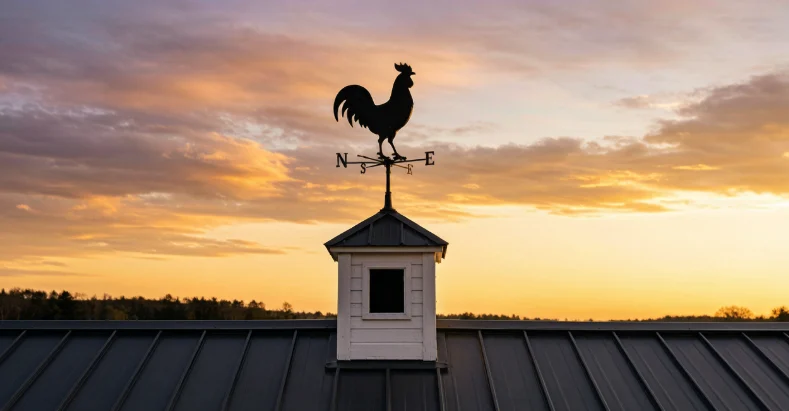
There is a specific moment in an American neighborhood — usually a late-afternoon walk in June — when you look up and notice it: a rooster on a rooftop, turning slowly into the wind. Then another one, three houses down. Then an arrow on a garage cupola, a horse on a barn ridge, a heron above a garden shed.
Weathervanes are back, and the comeback is quieter than most trends — because it happens forty feet up, one roofline at a time. But the numbers underneath are loud: the weather vane, an ornament older than the country itself, has become one of the fastest-replenished categories in garden centers, hardware stores, and gift catalogs.
The reasons are worth understanding, because they say something about where garden decor is heading. After a decade of minimalist everything, homeowners are reaching back for objects with heritage weight — pieces that look like they’ve always been there. And nothing in the garden inventory carries heritage like a weathervane. It’s the only ornament your great-grandfather would recognize instantly, and the only one that still performs its original job: reading the wind, in real time, from anywhere in the yard.
Here’s the full picture — the history that explains the styles, the materials that matter at rooftop height, the mounting knowledge nobody tells you, and what custom manufacturing looks like on the back end.
Every garden ornament category sells a look. The weathervane sells something extra: function with a soul.
The styling rule that separates a good installation from a hardware-store cliché: the weathervane must read at distance. At forty feet and in silhouette, detail disappears — what remains is shape. That’s why the classic forms have survived a century of design fads: roosters, arrows, horses, and birds are shapes that stay legible at any distance, in any light, against any sky.
The rooster weathervane is to this category what the red rose is to floristry: never out of style, never out of stock. The form descends from a papal decree in the ninth century (a rooster on every church steeple, a call to vigilance) and landed on American barns with the first settlers. Today’s versions split into two looks: the detailed traditional copper rooster weathervane, and the flat-silhouette steel rooster that reads cleaner on modern rooflines. The rooster’s staying power is simple — it’s the most recognizable animal silhouette in Western culture, it nods to the farmhouse aesthetic without trying, and it photographs beautifully against evening sky.
The arrow weathervane — a simple arrow and N-S-E-W crosshead, no figure at all — is the category’s fastest-growing segment, riding the modern-farmhouse and minimalist movements. On a matte-black standing-seam roof, a black arrow directional is practically architecture. Designers love it because it says “weathervane” without saying “barnyard.” The trend has pulled the whole category younger: first-time buyers who would never mount a rooster will happily mount an arrow.
The horse weathervane is the classic Americana form — the trotting racer and the standing mare were the two bestselling vanes of the nineteenth century, and originals now sell at auction as folk art. Current production keeps the silhouettes and updates the finishes: black steel and zinc for the modern barn, polished copper for the traditional one. This is the segment where the category’s heirloom pricing lives — a well-made copper horse is bought once and inherited.
Herons, loons, ducks in flight, and the ever-popular crowing rooster’s quieter cousin, the owl: bird weathervanes anchor the coastal and lakeside markets, where a heron vane above a boathouse reads as inevitable rather than decorated.
The sailboat weathervane owns the coastline — a full-rigged sloop turning in the harbor breeze is the East Coast summer-house signature. Coastal regions buy weathervanes at roughly double the inland rate, and the nautical motifs (sailboat, anchor, marlin) are why.
The category’s growth margin: family monograms, ranch brands, dog breeds, fire trucks, golf swings. Custom weathervanes run through the same manufacturing pipeline as standard forms (see the B2B section) and command heirloom pricing — a personalized vane is the rare gift that gets hung on a roof for forty years.
The quiet volume leader: not every weathervane goes on a roof. The garden weathervane on a post or rail-mount brings the category to renters, urban yards, and decks — no ladder, no roof work, all of the movement. Smaller figures, shorter spindles, same physics.
A weathervane lives in the harshest retail-adjacent environment in decor: full sun, full wind, rain, ice, and forty feet of fall if a mount fails. Material choice is not aesthetic here — it’s structural.
| Material | Look | Outdoor Lifespan | Verdict |
|---|---|---|---|
| Copper | Polished → living patina | Generations | The heirloom standard — turns brown, then green, then priceless |
| Steel (painted / powder-coated) | Crisp, matte, modern | 10–20 years | The volume leader — black steel arrow vanes |
| Zinc / galvanized | Soft silver-gray | 20+ years | The quiet traditionalist’s choice |
| Aluminum | Light, any color | 15+ years | Coastal — salt-proof and roof-weight-friendly |
| Vinyl / plastic | “Looks like” copper | 2–4 seasons of fading and wobble | The category’s cautionary tale |
Copper weathervanes hold the category’s premium tier for a reason no finish can fake: copper is the only material whose aging is the product. A new copper rooster is bright as a penny; five years on, it’s bronze-brown; twenty years on, it’s the green verdigris everyone photographs. A steel vane can be painted to look like aged copper — and every homeowner who buys one eventually wishes they’d bought the real thing. The steel weathervane counter-argument is honest too: it’s a third the price, structurally stiffer in wind, and the matte-black finish matches the roofs of the last fifteen years.
One engineering note that separates a real instrument from a lawn-ornament imitation: the bearings and the balance. A serious weather vane turns on a stainless or bronze bearing, is balanced so it swings freely in a two-mile-per-hour breeze, and has a spindle rigid enough not to whip in a gale. Cheap vanes wobble, seize, and eventually spin rustily in place — which is why the standing rule from every category applies hardest up here: if the listing doesn’t name the material and the bearing, assume it’s the kind that fails.
Half of all weathervane disappointment is installation, not product. The category’s unwritten curriculum:
The commercial side of weathervanes is a collector’s market wearing a hardware-store label — and custom metal manufacturing sits squarely at its center of value.
Specialist weathervane manufacturers now run full OEM/ODM programs, which in practice means:
Three category-specific notes for buyers: first, the gift-and-heirloom curve is the category’s hidden engine — copper and custom vanes sell year-round as housewarming, retirement, and memorial gifts, independent of the gardening season that drives the rest of outdoor decor. Second, the attach-rate economics are exceptional — every vane implies a mount, and often a cupola, a second vane for the garage, and a garden-post version for the yard; programs designed as systems capture the full basket. Third, freight is figure-shaped, not box-shaped — flat silhouette figures pack efficiently in slim cartons while looking premium on the shelf; dimensional-weight costs stay low for the perceived value delivered.
The buyers seeing the best results arrive with a roofline story (traditional barn vs. modern farmhouse vs. coastal), a material tier target, and a custom-silhouette plan for the gift channel — which turns an inquiry into a sample run within weeks.
Do weathervanes actually work — or are they just decoration?
Both, honestly. A balanced vane genuinely reads wind direction in real time; it won’t forecast weather. The old folklore (“rooster crowing into the west means rain”) has a kernel of science — prevailing-west storms — but the forecast you want still comes from your phone.
Which way should the arrow point?
The figure always points into the wind — that’s the physics and the whole point. The N-S-E-W crosshead is set once at installation with a compass (or a phone), then never touched again.
Can I mount a weathervane without piercing my roof?
Yes — standing-seam metal roofs take clamp mounts with zero drilling, and rail-mount and garden-post styles need no roof at all. On shingle roofs, a properly flashed ridge bracket is a one-time, weatherproof installation.
Is a copper weathervane worth three times a steel one?
If you’ll be in the house for a decade, yes — the patina is the product, and copper vanes outlast the roof under them. If it’s a starter home or a first experiment, black steel delivers ninety percent of the look at a third of the price.
Do I need a cupola?
Structurally, no. Visually, it’s the best upgrade in the category — it raises the vane into cleaner air, doubles the roofline presence, and turns installation into a bolt-on job.
Trends in garden decor usually arrive loudly — a color, a material, a viral silhouette. The weathervane came back the old way: quietly, roof by roof, carried by people who wanted their house to look like it had a story.
That’s what the ornament does. It’s a machine from the ninth century that reads the wind, a sculpture that finishes a roofline, and an heirloom you can buy in an afternoon. The rooster your great-grandfather would recognize is still turning on rooftops — and now there’s a matte-black arrow next door, and a heron on the house by the lake.
Put something on the peak. The wind is already there — it might as well be telling you something.